AAFC Continues With Plan to Terminate Canada’s Only Federal Organic Research Program Despite All-Party Warning
A Statement from SaskOrganics-June 3, 2026
SaskOrganics is calling on Agriculture and Agri-Food Canada and the Government of Canada to immediately pause further operational decisions affecting the Organic and Regenerative Research Program at the Swift Current Research and Development Centre and protect the continuity of Canada’s only dedicated long-term federal organic agriculture research program.
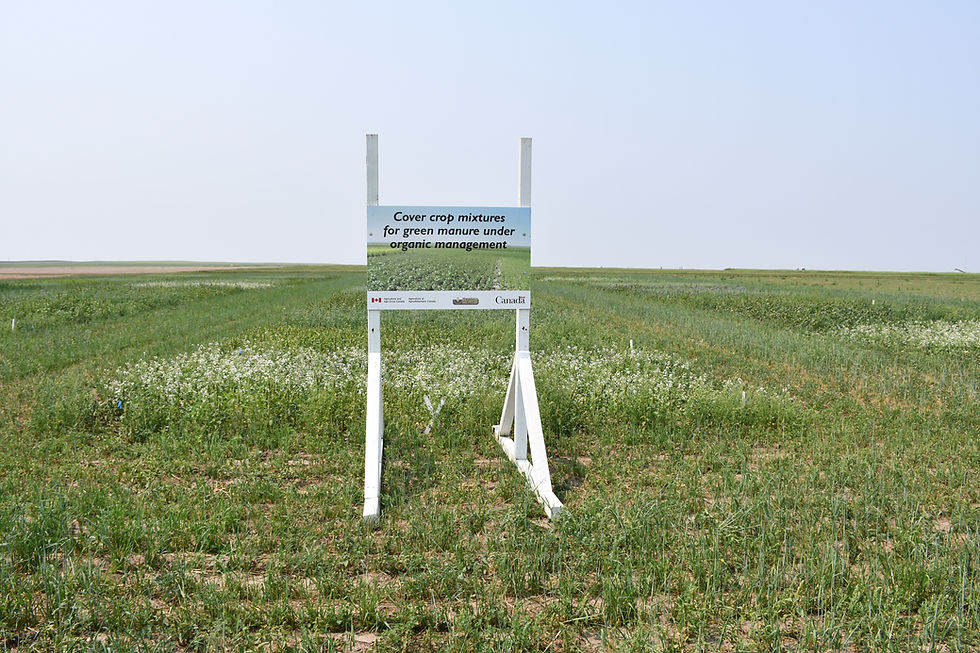
On May 28, the established organic research plots associated with the program were cultivated in preparation to be seeded uniformly with wheat. While AAFC has indicated that the land will remain under organic management, maintaining organic land is not the same as maintaining a long-term organic research program.
The scientific value of the Swift Current program depends on continuous trials, long-term crop rotations, accumulated datasets, scientific oversight, and nearly two decades of integrated organic management. Seeding the land uniformly does not preserve the research platform that made the program nationally significant, nor does it address the calls from producers, researchers, sector organizations, and Parliament to reconsider the program’s cancellation.
The House of Commons Standing Committee on Agriculture and Agri-Food recently issued unanimous all-party recommendations calling on the Government of Canada to reconsider the decision to cancel the Organic and Regenerative Research Program at Swift Current, table an action plan for affected agricultural research, and pause and reverse agricultural research closures announced in January.
Irreversible decisions affecting this long-term research program should not proceed before the government has tabled its response to the committee’s report.
The Organic and Regenerative Research Program is the only dedicated organic research program operated by AAFC in Canada. For nearly two decades, it has supported practical, regionally adapted research on soil health, weed and pest management, disease suppression, fertility management, crop rotations, low-input production systems, agronomic resilience, crop diversification, greenhouse gas mitigation, cover cropping, and climate adaptation.
This work benefits not only organic farmers, but also conventional and low-input or regenerative producers seeking solutions to rising input costs, climate variability, soil degradation, and market uncertainty.
Given the program’s uniqueness, alignment with AAFC priorities, externally funded research, the support of a variety of organizations that see value in diversified research, and limited apparent operational savings potential, it is difficult to understand the rationale for closing this program. The Swift Current Research and Development Centre itself remains operational, meaning this decision does not appear to achieve meaningful facility consolidation or “bricks and mortar” savings.
The decision to proceed with cultivation and seeding also follows a joint letter signed by 26 organizations and sent to the Assistant Deputy Minister of AAFC’s Science and Technology Branch, urging AAFC to pause the closure of the program and avoid actions that could further compromise its continuity.
A long-term organic research program cannot simply be recreated, relocated, or replaced with isolated organic projects elsewhere. Its value depends on continuous management, long-term rotations, regional conditions, historical data, and the expertise of the research team that has built and maintained the platform over time.
Although AAFC has stated that the plots are being managed with organic status in mind, this does not preserve the integrity of the long-term research program. It does not restore affected ongoing and planned research, and it does not protect the scientific continuity required for the program to resume if the cancellation is reversed.
SaskOrganics is deeply concerned that operational decisions are proceeding before the Government of Canada has responded to the AGRI Committee’s recommendations. The organization is urging AAFC to immediately pause any further work on the plots that would compromise the ability of the Organic and Regenerative Research Program to resume, reinstate affected research where possible, and work with researchers, producers, employees, Parliament, and sector stakeholders on a credible path forward.
The issue is not whether organically managed land remains at Swift Current. The issue is whether Canada will continue to maintain its only dedicated long-term federal organic agriculture research program.
There is still time to prevent further damage, but only if AAFC and the Government of Canada act now.
Background: The Strategic Value of Canadian Organics
Canada’s organic sector is economically significant. Canada’s organic market is valued at more than $11.88 billion, making Canada the fifth-largest organic market in the world.
Domestic organic production has not kept pace with consumer demand. This has increased reliance on imports and created missed opportunities for Canadian farmers, processors, and rural economies.
Canada also has significant organic trade opportunities. Organic equivalency arrangements provide access to international markets, and stronger domestic organic production would help Canadian farmers and processors capture a greater share of growing demand.
Publicly funded organic and low-input research is essential to supporting producers. The Swift Current program provides regionally adapted information that helps organic and non-organic farmers improve soil health, manage weeds and pests, diversify rotations, reduce input reliance, and adapt to climate pressures.
Organic production can also support farm profitability and national resilience goals. Research by the Organic Task Force found that organic production can deliver higher net returns per acre and that expanding organic production could dramatically reduce synthetic fertilizer use, pesticide use, and greenhouse gas emissions.
Long-term organic field trials cannot easily be recreated. Their value depends on continuous management, long-term rotations, regional conditions, and accumulated scientific datasets. Protecting the Swift Current program is therefore essential to protecting Canada’s organic research capacity.